Ebb Tidal Delta
Avon-Heathcote Estuary mouth · Deposition landform · SECCE
The landform
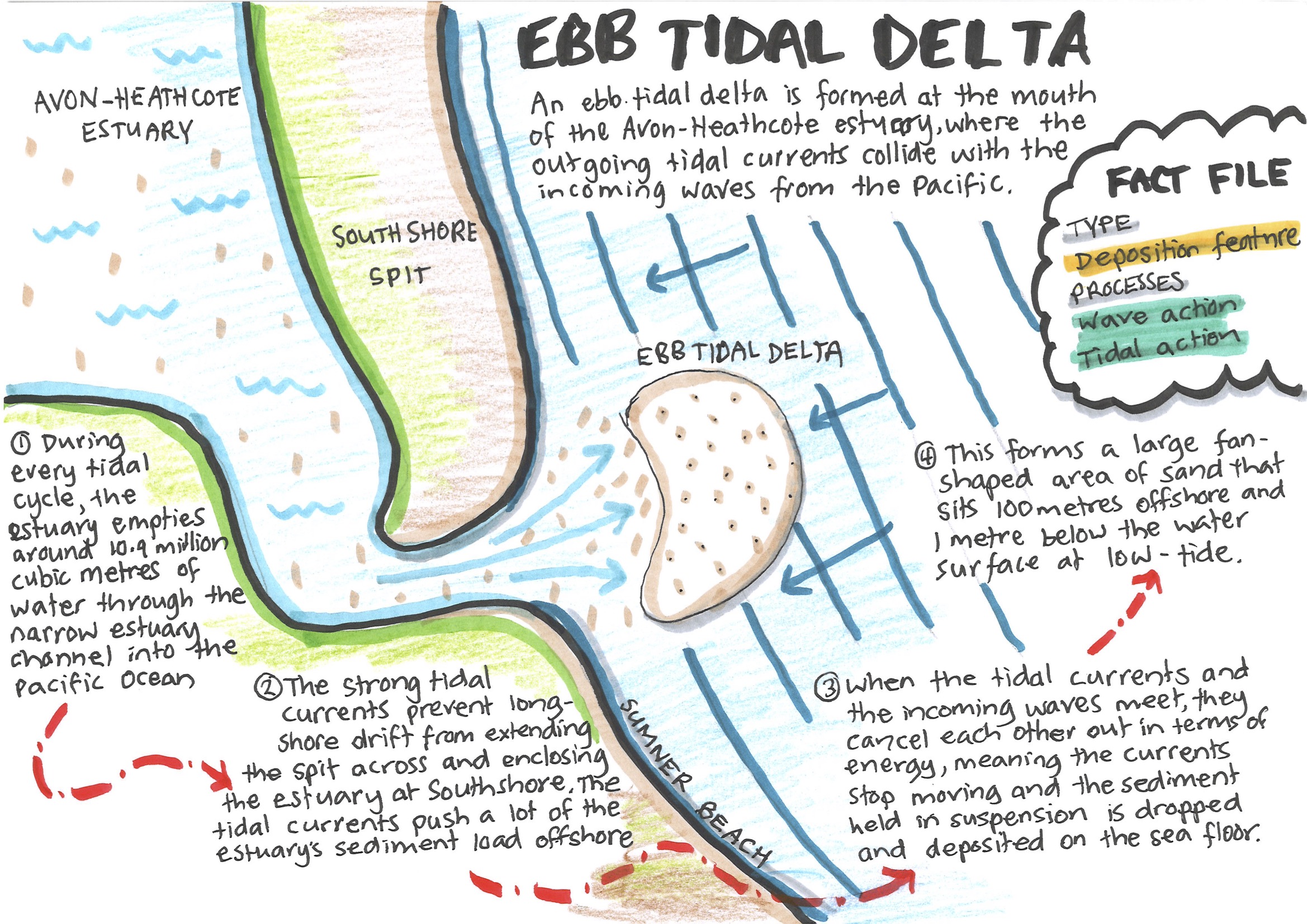
An ebb tidal delta is formed at the mouth of the Avon-Heathcote Estuary, where the outgoing tidal currents collide with the incoming waves from the Pacific Ocean.
During every tide cycle, the estuary empties around 10.9 million cubic metres of water through the narrow estuary entrance into the Pacific Ocean. The strong tidal currents prevent longshore drift from extending the spit across and enclosing the estuary at Southshore. The tidal currents push a lot of the estuary’s sediment load offshore.
When the tidal currents and the incoming waves meet, they cancel out each other’s energy, meaning the currents stop moving and sediment held in suspension is dropped and deposited on the sea floor.
This forms an ebb tidal delta, a large fan-shaped area of sand that sits 100 m offshore, just 1 metre below the surface of the water at low tide.
The diagram
Fact file
- Landform
- Ebb tidal delta
- Type
- Deposition feature
- Processes
- Wave action · Tidal action
- Key facts
- Around 10.9 million m³ of water each tide cycle · Fan-shaped · 100 m offshore · 1 m below the surface at low tide
Time-lapse video of the diagram
Using it in the exam
Question A (how processes shaped the environment): the ebb tidal delta is one of the deposition features you can choose from. You could start its paragraph like this:
“Further north, at the mouth of the Avon-Heathcote Estuary, is another deposition feature: an ebb tidal delta.”
Link it to the spit: the same tidal currents that build the delta also stop the spit at Southshore from growing across the estuary mouth. Showing how the two landforms interact is a strong way to show interaction as a geographic concept. See the Southshore Spit page.